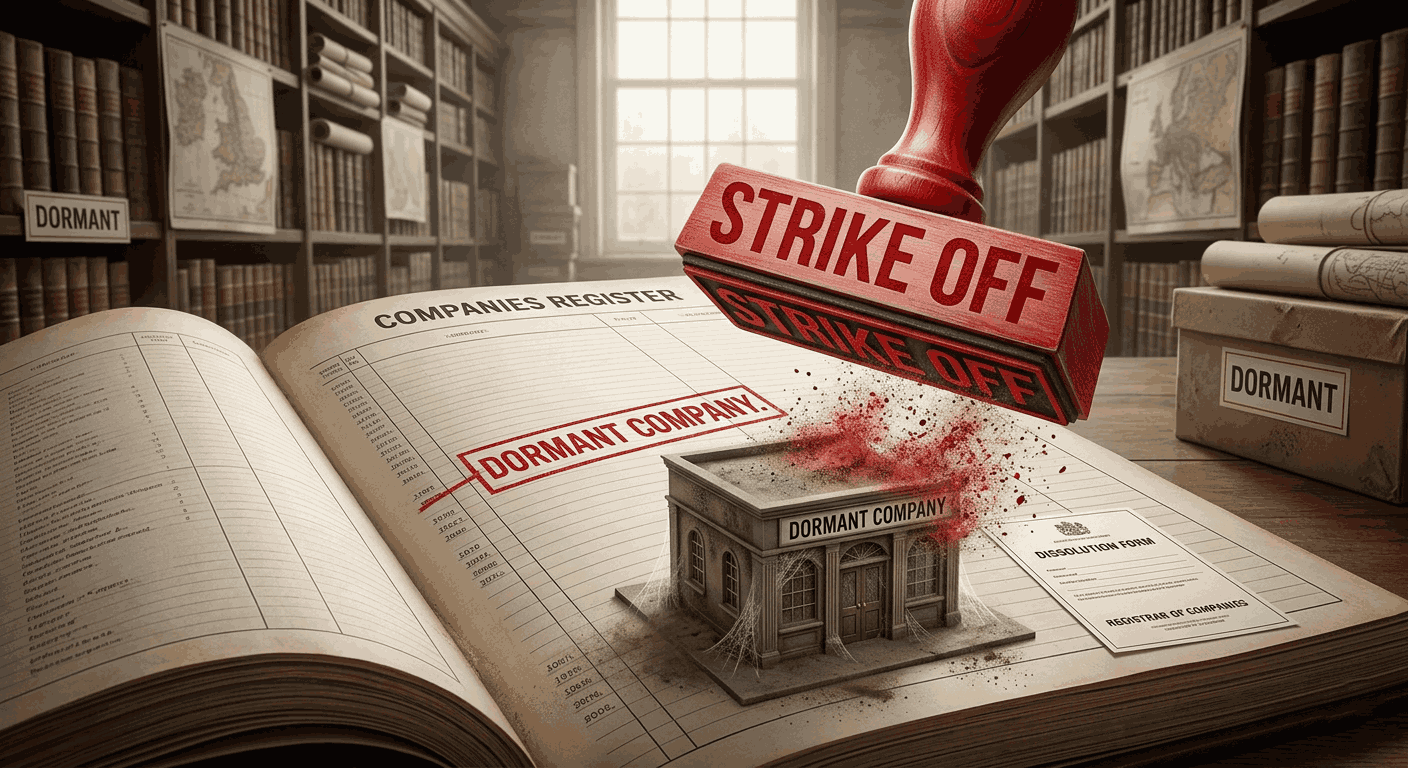
In India, the Companies Act, 2013 provides mechanisms for handling companies that are not actively trading. Understanding the difference between a Dormant Company (a "pause" button) and a Strike Off (a "stop" button) is crucial for regulatory compliance and reducing unnecessary operational costs.
Dormant Company (Section 455)
A dormant company is an active company that has temporarily stopped operations, or was formed for a future project, to hold an asset/intellectual property, and has no significant accounting transactions.
Key Idea: It is a strategic move to "pause" a company to save on compliance costs while keeping the entity alive for future use, holding assets, or protecting a brand name.
Conditions: Must have no significant accounting transactions in the last two financial years. It cannot have any outstanding secured or unsecured loans (if it does, lender consent is required).
Process: A special resolution must be passed by shareholders, and an application filed with the Registrar of Companies (ROC) in Form MSC-1.
Time Limit: A company can remain in dormant status for a maximum of 5 consecutive years.
Reactivation: To resume operations, file Form MSC-4 to revert to active status.
Strike Off of Company (Section 248)
Strike Off is the process of removing a company's name from the Register of Companies maintained by the ROC. This results in the formal dissolution of the company.
Key Idea: It is an alternative to formal winding up (liquidation) for inoperative or defunct companies, allowing for a faster, simpler, and more cost-effective closure.
Modes of Strike Off:
Voluntary (Section 248(2)): Initiated by the company when it has no business, no assets, and no liabilities. Requires 75% shareholder approval.
Suo-moto by ROC (Section 248(1)): Initiated by the Registrar if the company fails to commence business within one year, or has not carried on business for the two preceding financial years.
Process: File Form STK-2 along with an indemnity bond (STK-3) and affidavit (STK-4).
Consequences: The company ceases to exist as a legal entity, but directors/members remain liable for actions taken before dissolution.
ROC Compliance Requirements
Compliance needs to be maintained to avoid penalties or involuntary striking off.
A. For Dormant Companies:
Form MSC-3: File a "Return of Dormant Company" annually, audited by a CA, within 30 days of the end of each financial year.
Board Meetings: At least one board meeting must be held in each half of a calendar year.
Director KYC: Annual KYC for directors (DIR-3 KYC).
B. For Active/Going-to-be-Struck-Off Companies:
Overdue Filings: A company cannot strike off unless it has filed all overdue financial statements (AOC-4) and annual returns (MGT-7) up to the end of the financial year in which it ceased operations.
Closure Checklist: Clear all creditors, close bank accounts, and settle statutory dues.